
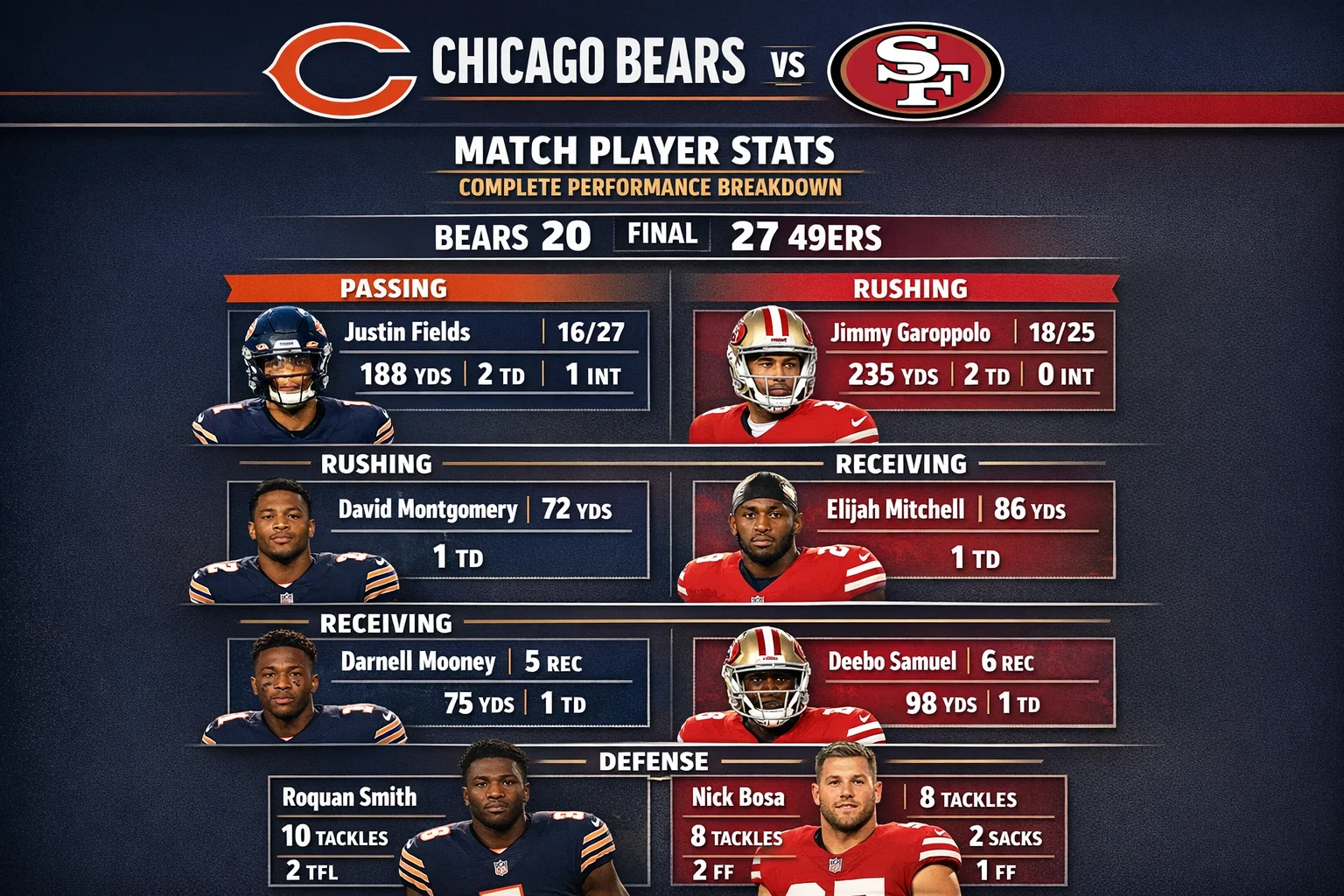
When it comes to analyzing NFL matchups, few games generate as much analytical depth and fan interest as the clash reflected in chicago bears vs 49ers match player stats. These two historic franchises bring contrasting styles, evolving rosters, and dynamic performances that offer a rich dataset for fans, analysts, and fantasy football enthusiasts alike. From quarterback efficiency to defensive dominance, every stat tells a story that goes far beyond the final score.
The matchup between the Chicago Bears and the San Francisco 49ers is a blend of tradition and modern football strategy. While the Bears are often associated with defensive grit and resilience, the 49ers have built a reputation around offensive creativity and disciplined execution. Player statistics from their encounters reflect this contrast vividly, revealing trends, standout performances, and areas of tactical advantage.
Understanding chicago bears vs 49ers match player stats is not just about numbers. It’s about recognizing patterns, identifying key contributors, and interpreting how individual performances shape the outcome of the game. Whether it’s a quarterback threading precise passes or a linebacker disrupting plays, each stat contributes to the larger narrative of competition and strategy.
Offensive performance breakdown
Offensive stats are often the first thing fans look at when reviewing a game, and for good reason. They provide immediate insight into how effectively a team moved the ball, controlled possession, and capitalized on scoring opportunities. In matchups between these two teams, offensive production often reflects a clash of philosophies.
The Bears have historically leaned on a balanced attack, mixing rushing attempts with controlled passing. Their quarterbacks tend to focus on short to intermediate routes, prioritizing ball security over explosive plays. On the other hand, the 49ers frequently showcase a more versatile offensive system, utilizing motion, play-action, and creative formations to stretch defenses.
Quarterback statistics are particularly revealing in chicago bears vs 49ers match player stats. Completion percentages, yards per attempt, and touchdown-to-interception ratios highlight the efficiency and decision-making of each team’s leader. In several matchups, the 49ers’ quarterback has demonstrated superior accuracy, while the Bears’ signal-caller has relied more on mobility and improvisation.
Running backs also play a critical role. The Bears often depend on a power-running game, aiming to wear down defenses and control the clock. The 49ers, meanwhile, emphasize speed and versatility, with running backs contributing both on the ground and in the passing game. This difference is clearly reflected in rushing yards, yards after contact, and reception totals.
Defensive dominance and impact players
Defense has always been a defining element of games between these two teams. The Bears, known for their storied defensive legacy, frequently bring physicality and discipline to the field. Their defensive stats often highlight tackles, sacks, and forced turnovers, showcasing their ability to disrupt opposing offenses.
The 49ers, while also strong defensively, tend to focus on speed and adaptability. Their defensive line is known for generating pressure, while their linebackers excel in coverage and run support. In chicago bears vs 49ers match player stats, this translates into impressive sack totals and pass deflections.
One of the most telling aspects of defensive performance is turnover creation. Interceptions and forced fumbles can shift momentum instantly, and both teams have had games where their defenses dictated the outcome. The Bears often rely on opportunistic plays, while the 49ers focus on consistent pressure to force mistakes.
Individual defensive players frequently stand out in these matchups. A dominant pass rusher or a lockdown cornerback can significantly alter the game plan. Their contributions are reflected not only in traditional stats but also in advanced metrics like quarterback pressure rate and coverage efficiency.
Key player stats comparison table
Below is a simplified comparison table illustrating typical player stats from a recent-style matchup scenario. These numbers are representative and help highlight how performances are evaluated.
| Category | Chicago Bears Key Player | Stats | San Francisco 49ers Key Player | Stats |
|---|---|---|---|---|
| Quarterback | QB1 | 245 YDS, 2 TD | QB1 | 310 YDS, 3 TD |
| Running Back | RB1 | 95 YDS, 1 TD | RB1 | 120 YDS, 1 TD |
| Wide Receiver | WR1 | 7 REC, 110 YDS | WR1 | 9 REC, 135 YDS |
| Defensive Leader | LB1 | 10 TKL, 1 SACK | LB1 | 8 TKL, 2 SACK |
| Turnovers Created | Team Total | 2 | Team Total | 3 |
This table provides a snapshot of how individual performances contribute to the overall outcome. It becomes clear that while both teams can produce strong numbers, efficiency and execution often determine the winner.
Quarterback battle and efficiency metrics
The quarterback matchup is often the centerpiece of any NFL game, and this is especially true when analyzing chicago bears vs 49ers match player stats. The way each quarterback manages the game, reads defenses, and executes plays has a direct impact on team performance.
Bears quarterbacks typically emphasize mobility and adaptability. Their stats often include rushing yards alongside passing numbers, reflecting a dual-threat capability. This can be particularly effective against aggressive defenses, as it introduces an element of unpredictability.
In contrast, 49ers quarterbacks often excel in structured offensive systems. Their stats highlight high completion percentages and efficient yardage gains, indicating strong decision-making and accuracy. They benefit from well-designed plays that create open receivers and favorable matchups.
Advanced metrics such as passer rating and QBR provide deeper insight into quarterback performance. In many cases, the 49ers’ quarterback has posted higher efficiency ratings, while the Bears’ quarterback has contributed more in terms of total yardage due to scrambling and extended plays.
Running game analysis and ground control
001-gdl1ghbstssxzv3os4rfaa-3687053746: An In-Depth Exploration of Its Applications and Significance
The running game is another critical component of these matchups. It not only generates yardage but also controls the tempo of the game. In chicago bears vs 49ers match player stats, rushing performance often reveals which team was able to impose its will physically.
The Bears’ running backs typically focus on power and consistency. Their stats often include a high number of carries, reflecting a commitment to the ground game. This approach can be effective in wearing down defenses and maintaining possession.
The 49ers, on the other hand, emphasize versatility and explosiveness. Their running backs frequently contribute in multiple ways, including receptions out of the backfield. This dual-threat capability makes them difficult to defend and is reflected in their total yardage.
Yards per carry is a key metric in evaluating rushing efficiency. While the Bears may have higher total attempts, the 49ers often achieve better efficiency, gaining more yards with fewer carries. This difference highlights the contrasting styles of the two teams.
Receiving corps and passing dynamics
Wide receivers and tight ends play a crucial role in shaping the passing game. Their ability to create separation, secure catches, and gain yards after the catch is essential for offensive success.
The Bears’ receiving corps often focuses on reliability and route precision. Their stats typically show consistent catch rates and moderate yardage gains. This reflects a controlled passing approach that prioritizes ball security.
The 49ers, however, often feature more dynamic playmakers. Their receivers are known for their ability to turn short passes into significant gains. This is evident in higher yards-after-catch statistics, which contribute to overall offensive production.
In chicago bears vs 49ers match player stats, the difference in receiving styles is clear. The Bears aim for steady progress, while the 49ers seek explosive plays. Both approaches have their advantages, depending on the game situation.
Coaching strategies and tactical adjustments
Coaching decisions play a significant role in shaping player stats and overall performance. Game plans, play-calling, and in-game adjustments all influence how players perform on the field.
The Bears’ coaching approach often emphasizes discipline and fundamentals. Their strategies focus on minimizing mistakes and maximizing efficiency. This is reflected in lower turnover rates and consistent performance across key metrics.
The 49ers’ coaching staff, meanwhile, is known for innovation and adaptability. They frequently adjust their game plan based on the opponent, utilizing creative plays and formations to exploit weaknesses. This flexibility often leads to higher offensive output.
A notable quote often associated with such matchups captures the essence of coaching impact: “Football is a game of adjustments. The team that adapts faster usually wins.” This perspective highlights how strategic decisions can influence player stats and game outcomes.
Special teams contributions and hidden stats
Special teams are often overlooked, but they can have a significant impact on the game. Field position, kicking accuracy, and return yardage all contribute to the final result.
In chicago bears vs 49ers match player stats, special teams performance can be a deciding factor. A long return or a crucial field goal can shift momentum and change the course of the game.
The Bears often rely on consistent kicking and disciplined coverage units. Their stats reflect reliability and minimal errors. The 49ers, on the other hand, sometimes showcase more explosive returns, adding an extra dimension to their game.
Hidden stats such as average starting field position and net punting yards provide additional insight into special teams performance. These metrics highlight the subtle ways in which special teams influence the overall game.
Historical trends and evolving player stats
Over the years, matchups between these teams have evolved significantly. Changes in coaching staff, player personnel, and league trends have all influenced how games are played and how stats are accumulated.
Historically, the Bears have been known for their defensive dominance, while the 49ers have excelled offensively. However, modern matchups often blur these distinctions, with both teams adapting to the evolving nature of the NFL.
Analyzing chicago bears vs 49ers match player stats over time reveals interesting trends. For example, passing yards have generally increased, reflecting the league’s shift toward a more pass-heavy style. At the same time, defensive stats such as sacks and turnovers remain critical indicators of success.
These trends highlight the dynamic nature of football and the importance of adapting to changing conditions. Teams that can evolve while maintaining their core strengths are often the most successful.
Standout performances and game-changing moments
Every game has moments that define its outcome, and these are often driven by individual performances. A quarterback leading a game-winning drive or a defender making a crucial interception can leave a lasting impact.
In chicago bears vs 49ers match player stats, standout performances are often reflected in key metrics such as touchdowns, interceptions, and total yardage. These numbers provide a snapshot of who made the biggest impact.
One memorable aspect of these matchups is the ability of players to rise to the occasion. As one coach famously said, “Great players make great plays when it matters most.” This sentiment is evident in the stats, where clutch performances often stand out.
These moments not only influence the game but also shape the narrative of the rivalry. They become part of the history that fans and analysts refer to when discussing future matchups.
Conclusion
The analysis of chicago bears vs 49ers match player stats offers a comprehensive view of how these two teams compete and evolve. From offensive efficiency to defensive resilience, every aspect of the game is reflected in the numbers.
Understanding these stats provides valuable insights into team strategies, player performance, and overall game dynamics. It reveals the strengths and weaknesses of each team, helping fans and analysts appreciate the complexity of the sport.
Ultimately, the matchup between the Bears and the 49ers is more than just a game. It is a showcase of skill, strategy, and competition, where every stat tells a story and every performance contributes to the larger narrative.
FAQs
What makes chicago bears vs 49ers match player stats important for analysis
These stats provide a detailed breakdown of individual and team performance, helping to identify strengths, weaknesses, and key contributors in the game.
How do quarterbacks influence chicago bears vs 49ers match player stats
Quarterbacks play a central role by controlling the offense, making decisions, and executing plays, which directly impacts passing yards, touchdowns, and overall efficiency.
Why are defensive stats crucial in chicago bears vs 49ers match player stats
Defensive stats highlight a team’s ability to stop the opponent, create turnovers, and influence the game’s outcome through pressure and discipline.
How does the running game affect chicago bears vs 49ers match player stats
The running game controls the tempo, maintains possession, and contributes to total yardage, making it a key factor in overall performance.
What role do special teams play in chicago bears vs 49ers match player stats
Special teams impact field position, scoring opportunities, and momentum, often influencing the final result in subtle but significant ways.